How to Judge a Content Writer’s Revision Process
How to judge a content writer’s revision process before hiring: A weak content writer revision process will cost you time, tone, and trust before the…
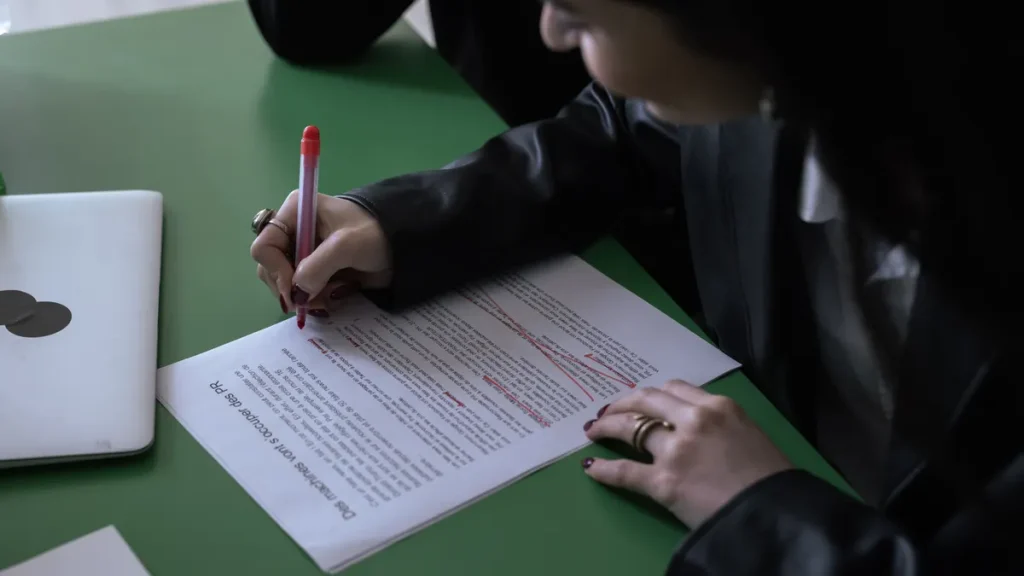
Person marking edits on a printed document with a red pen
Last updated: November 12, 2026
A weak content writer revision process will cost you time, tone, and trust before the first draft is even approved.
Judge the process by how clearly the writer handles tracked changes, editor comments, revision requests, and the approval process.
The steps below show what to ask, what to look for, and where the red flags show up fast.
Our Top 3 Picks at a Glance
| Option | Best For | Core Spec | Standout Feature | Action |
|---|---|---|---|---|
| #1 Best Overall | Hiring a writer for ongoing work | A revision workflow that uses tracked changes and clear feedback loops | Clear scope for each revision round | Ask for a sample approval process |
| #2 Best Budget Pick | Small projects with limited edits | A simple one-round revision process | Fast comment handling | Ask how revision requests are handled in writing |
| #3 Best Heavy-Duty / Upgrade Pick | Brands that publish often | A multi-step handoff process with editor comments | Defined ownership for each stage | Ask for a full revision workflow example |
How do you judge a content writer’s revision process before hiring?

You judge it by asking for a real revision workflow, not a promise.
A writer who can explain one round, two rounds, or a fixed approval process in plain language is easier to trust than one who says they are “flexible” and leaves the rest vague.
The best signal is how the writer talks about changes after the first draft. A solid answer names the tool, the handoff, and the limit on scope. You want to hear words like tracked changes, editor comments, and revision request in the same answer.
Picture this: you’re on a hiring call, and the writer says they revise “until you’re happy.” That sounds friendly. It also hides the cost, the delay, and the point where the draft stops being one article and becomes a moving target. Not good.
Ask for these four things:
- How revision notes are shared
- Who marks comments and who answers them
- What counts as a small edit versus a rewrite
- How approval is signed off
What should a good revision workflow include?
A good revision workflow includes tracked changes, editor comments, a revision request, and an approval process.
If one of those pieces is missing, the writer may still be talented, but the process is hard to judge before you hire.
Picture this: you send a brief, get a draft, and then have to repeat yourself in email, chat, and a Google Doc. That’s not a process. That’s a scavenger hunt. The writer should already know where comments go, who answers them, and how the final approval happens.
Here’s the catch: a strong workflow is not just about speed. It also shows how the writer handles pressure when the feedback is messy or contradictory.
Look for these concrete pieces:
- Tracked changes in a shared document, so you can see exactly what changed.
- Editor comments with replies, so the writer doesn’t guess at intent.
- A defined revision round limit, such as first pass and final pass.
- A named approval process, so the draft doesn’t sit in limbo.
- A clear handoff point from draft to approved copy.
If the writer cannot describe that chain in 60 seconds, keep asking.
Which revision questions tell you the most?

The right questions tell you whether the writer can separate useful edits from scope creep.
Ask these in the interview, and ask them in writing too, because vague answers sound better on a call than they do in an inbox.
Picture this: you need the writer to fix a headline, tighten a conclusion, and add one source. That is a normal revision request. What you do not want is a writer who treats every small note like a full rewrite, or one who ignores notes unless you restate them twice.
Use these questions:
- “How do you handle tracked changes?”
- “What happens when editor comments conflict?”
- “How many revision rounds do you include?”
- “What does your approval process look like?”
- “What is outside the revision scope?”
A good answer will name the file type, the channel, and the cutoff. For example, the writer might say edits come back in Google Docs with tracked changes, comments are answered in-thread, and anything beyond a 20% rewrite needs a new quote. That kind of answer is specific. The weak answer is “I’m easy to work with.”
The best part? You can compare writers on process without judging style alone. A writer with a clean revision system often causes fewer delays later, even if the first draft is only decent.
How many revision rounds should a writer offer?
A writer should name the number of revision rounds before you hire them.
The exact count matters less than the fact that it exists and is written down.
Picture this: you think you’re buying a draft and a light polish, but the writer thinks you want unlimited back-and-forth for 3 weeks. That mismatch burns time before the article is even published. A clear limit protects both sides.
Use this simple test:
- If the writer says one round, ask what counts as a major change.
- If the writer says two rounds, ask what happens after the second round.
- If the writer says unlimited, ask how they prevent endless drift.
- If the writer won’t name a number, treat that as a warning.
A strong answer usually sounds like this: first round for structure and factual fixes, final round for polish. That split is easy to manage. It also keeps the work from becoming a vague “keep tweaking it” cycle.
On the flip side, too rigid a process can be a problem too. If the writer refuses even small fixes after the first pass, you may be stuck with a draft that misses tone or brand fit. The sweet spot is clear, not stiff.
How do you spot a writer who handles comments well?
A writer who handles comments well answers them point by point and does not dodge the hard ones.
That sounds simple, but it’s one of the clearest signs you’ll get before hire.
Picture this: you leave five comments in a document, and the writer resolves three, replies to one, and ignores the last one because it feels inconvenient. That tells you more than a polished portfolio ever will. Comment handling shows whether the writer can work inside feedback, not just produce alone.
Watch for three behaviors:
- They answer comments in the same place they were left.
- They explain why they accepted or rejected a change.
- They separate opinion from error, such as tone versus fact.
A writer who can do that usually understands handoff pressure. They also know when to ask for clarification instead of guessing. That matters, because a revision round loses value fast when the writer fills gaps with assumptions.
A bad sign is defensiveness. If every note gets a debate, the approval process turns into a fight. Another bad sign is silence. If comments disappear with no reply, you’ll spend extra time chasing basic fixes.
What does a strong handoff process look like?
A strong handoff process ends with a clean file, a final check, and a clear owner for the next step.
If the writer can’t describe the handoff, they may not be thinking past the draft.
Picture this: the draft is approved, but the title is still in one doc, the meta description is in another, and the source links are buried in chat. That kind of handoff creates avoidable mistakes. A good writer knows what leaves the document, what stays with the editor, and what needs sign-off.
Ask how the writer handles these items:
- Final text after tracked changes
- Remaining editor comments
- Source links or notes
- Title and subhead changes
- The approval process for the final file
A clean handoff usually includes one final version, not three near-duplicates. It also shows who owns the last edit. If the writer says, “I send it back and you figure out the rest,” that’s not a handoff. That’s abandonment.
The truth is, a strong handoff often saves more time than a fast first draft. It cuts the risk of version confusion, missed notes, and last-minute rewrites.
What are the red flags in a revision process?
A weak revision process shows up as vagueness, defensiveness, and no written limits.
Those are the signs that matter before hire, because they usually predict the same mess later.
Picture this: the writer says revisions are “part of the service,” but can’t tell you where comments go or how long a round takes. That sounds accommodating. It usually means no one has defined the process, so every project becomes custom labor.
Red flags to watch for:
- No mention of tracked changes
- No clear answer on revision rounds
- No written approval process
- No distinction between a small edit and a rewrite
- No plan for handling conflicting editor comments
One more problem: some writers sell speed but hide cleanup work. A draft may arrive quickly, then stall during revisions because the writer never built a real feedback loop. That creates delay, not efficiency.
Big mistake. If the writer can’t describe the revision process in plain terms before the contract starts, you’ll probably end up managing it yourself later.
How do you compare two writers on revision process?
You compare them by how specific their process is, not by how pleasant they sound.
The better writer is usually the one who can show a clear path from draft to approval in a few sentences.
Picture this: both writers have decent portfolios. One says, “I’m flexible.” The other says, “I use tracked changes in Google Docs, answer comments in the file, and include two revision rounds before final approval.” The second answer is easier to trust because it is measurable.
Use this quick scorecard:
- Can they name the tool?
- Can they name the number of revision rounds?
- Can they explain the approval process?
- Can they handle scope changes without confusion?
- Can they separate feedback from rewrites?
If one writer is great on tone but fuzzy on process, that is a real trade-off. They may still be right for a one-off project with little oversight. If you need repeatable publishing, choose the writer with the better revision system.
The best fit is not the writer who promises endless edits. It’s the one who can make edits predictable.
Key Takeaways
- A writer’s revision process is easier to judge than their polish on first draft.
- The best signs are specific: tracked changes, editor comments, revision rounds, and a written approval path.
- Weak answers sound flexible but stay vague on limits, timing, and ownership.
- Good comment handling matters because it shows whether the writer can work inside feedback without turning each note into a fight.
- A clean handoff matters just as much as the draft itself, especially if you publish often.
How many revision rounds should a writer offer?
A writer should offer a number you can see in writing before the work starts.
One round may be enough for simple projects, while two rounds is common when tone, structure, and facts all need attention. The main point is not the count alone. It’s whether the writer defines what each round covers and what happens after that.
How do you ask about revisions before hiring?
Ask for the writer’s revision workflow in plain language.
Request an example of how they handle tracked changes, editor comments, and a final approval process. If the answer is vague, ask what is included, what is extra, and where revision requests should be sent.
What is a normal revision workflow?
A normal revision workflow starts with a draft, moves to comments in a shared file, and ends with a clean approval step.
The writer should know where to review notes, how to answer them, and when the file is ready to hand off. Google Docs with tracked changes is common, but the exact tool matters less than the clarity of the process.
Drafted with AI; not yet reviewed by a person.