Content Writer Hiring Checklist Before You Make an Offer
Content writer hiring checklist before you make an offer: use a content writer hiring checklist to finish your due diligence before you send the offer…

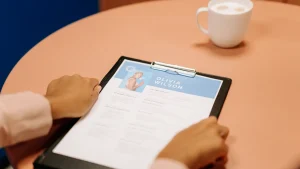
Job interview scene with resume sign
Last updated: October 21, 2026
In short: use a content writer hiring checklist to finish your due diligence before you send the offer, because the last 10% of vetting is where missed references, weak contract terms, and bad process fit usually hide. This piece walks through what to check, when to slow down, and when to move forward.
Key Takeaways
- Check verified evidence before money changes hands, not interview talking points.
- If samples look strong, confirm they are relevant, recent, and truly theirs.
- References matter most when the portfolio looks good but working habits are still unclear.
- A trial assignment is still useful when the exact work is not fully proven by samples and references.
If you already like the portfolio, the checklist is not about second-guessing the writer. It is about making sure the offer goes to someone who can actually deliver in your workflow, under your terms, without creating avoidable friction in the first month. That means checking the portfolio, calling references, deciding whether a short trial assignment is still needed, and confirming the contract terms before anyone signs.
What actually belongs on a content writer hiring checklist?

A content writer hiring checklist should cover the proof you can verify before money changes hands, not the interview questions you already asked. If the writer has strong samples but vague references, then the checklist should slow the process down. If the references are solid and the process fit is clear, then the checklist should help you move faster.
A useful checklist for this stage usually includes:
- Portfolio review against the formats you actually need.
- Reference checks with at least one recent editor, client, or manager.
- A short trial assignment if the portfolio does not show the exact work you need.
- Process fit: file delivery, revision rhythm, voice alignment, and response time.
- Contract terms: scope, ownership, confidentiality, payment schedule, and termination.
- Final offer approval from the person who will manage the writer.
If you are hiring for blog posts, landing pages, or long-form SEO pages, the portfolio should show more than polished prose. It should show the writer can handle structure, deadlines, subject-matter complexity, and the level of editing their work usually needs. A writer with a beautiful published piece may still be a poor fit if every draft needs heavy rewriting.
For a clean framework, I would treat the checklist like a gate, and if you want legal certainty, consult a qualified professional before you rely on it as a contract substitute. Nothing on the offer letter should be a surprise at this point. That is where the checklist earns its keep.
Quick check: if you still have unanswered questions about portfolio quality, reference reliability, or contract terms, you are not ready to issue the offer yet.
If the portfolio looks strong, what should you verify before you offer?
If the portfolio looks strong, then verify that the samples are relevant, current, and actually theirs. But if the samples are thin on the exact format you need, then the checklist should push you toward a trial assignment or a slower decision.
A portfolio review should answer three questions: can this person write in the format you need, can they do it at the level you need, and can they do it for your kind of subject matter? A writer who excels at listicles may struggle with technical explainers. A writer who handles SaaS content well may not be right for compliance-heavy or regulated topics.
Use a simple filter:
| Situation | Best Path | Why Other Options Fail |
|---|---|---|
| Samples match your format exactly | Move to references and contract review | A trial may be unnecessary if the portfolio already shows the work |
| Samples are polished but not relevant | Ask for one targeted trial assignment | Generic samples can hide weak process fit |
| Samples are strong but old | Verify recent work or ask for updated examples | Old samples may not reflect current standards |
| Samples include ghostwritten work | Confirm ownership and role clearly | Misattributed work can distort the decision |
When you review the portfolio, look for signs of structure, not just style. In 800-word or 1,500-word pieces, does the writer build an argument cleanly? Do headings make sense? Does the intro carry the reader forward? Does the piece use evidence without sounding padded? Those are the things that matter when the work leaves the portfolio and enters your workflow.
A quick pass through published work can also reveal whether the writer can adapt tone. If every sample sounds the same, that is a warning. If the voice shifts appropriately across brands or subjects, that is a better sign.
A practical checklist for the portfolio step:
- Match each sample to the exact job: blog, case study, homepage, email, or landing page.
- Check publication date or recency, especially if the field changes quickly.
- Look for evidence of structure: headings, transitions, and a clear point of view.
- Note whether the piece appears lightly edited or heavily rescued.
- Ask who owned the brief, the outline, and the final draft if that is unclear.
- Separate style preference from job fit so you do not hire for personal taste alone.
If the portfolio passes, the next question is not “Do I like this?” It is “Does this writer solve my problem with less risk than the next candidate?”
Quick check: if the samples prove polish but not relevance, the checklist is telling you to pause, not to rush.
How do reference checks change the decision?

Reference checks change the decision when the portfolio is promising but the working habits are still unknown. If the references confirm reliability, revision discipline, and communication, then the offer becomes much safer. If they reveal missed deadlines or messy handoffs, then the checklist should override the nice samples.
This is the part most generic hiring articles skip. A portfolio shows output. References show behavior.
Ask for references who can speak to actual working conditions: an editor, a marketing lead, a content manager, or a client who received multiple assignments over time. One glowing testimonial does not help much if it came from a one-off project with no revisions. What matters is how the writer handled feedback, deadlines, and ambiguity over at least a few deliverables. For guidance on reference checks, see the U.S. Equal Employment Opportunity Commission and the U.S. Department of Labor.
A useful reference check should cover:
- Turnaround on 500- to 2,000-word assignments.
- How often drafts needed major rewrites.
- Whether the writer asked clarifying questions early.
- How they responded to edits and conflicting feedback.
- Whether they met commitments without reminders.
If a reference says, “Great writing, but needed constant chasing,” that is not a soft concern. That is a process issue. A writer can be talented and still be wrong for a team that runs on tight launch dates or multiple stakeholder approvals.
Reference checks are especially important if you are outsourcing and the writer will work with little supervision. In that case, a clean reference is not a bonus. It is one of the few real signals you get before the first assignment.
A practical reference-check path:
- Ask the writer for 2 references from recent work, ideally within the last 12 months.
- Prefer references who reviewed drafts, not just approved invoices.
- Ask about deadline reliability and revision habits.
- Ask whether the writer handled feedback without defensiveness.
- Compare the reference answers against the portfolio and interview notes.
- Flag any mismatch between the writer’s claims and the reference’s description.
If the references are strong, you can move faster. If they are vague or unreachable, that is itself information.
Quick check: if you still do not know how the writer behaves under deadline pressure, the checklist is not complete.
Do you still need a trial assignment before the offer?
You still need a trial assignment when the portfolio and references do not fully prove the exact work you need. But if the job is highly standardized and the writer has already shown the same format plus strong references, then a trial may add delay without adding much signal.
This is where people go wrong: they use a trial assignment to recreate the whole hiring process. That is too late and too expensive. The point here is not to test writing from scratch. The point is to remove the last doubt before the offer.
A trial assignment works best when it is narrow. Give the writer a realistic brief, a defined word count, and a tight deadline, then judge whether they can follow instructions, structure the piece, and handle feedback. A 300- to 800-word assignment is often enough for a decision if the goal is process fit rather than a full publication-ready piece.
What to look for:
- Can the writer interpret the brief without overexplaining it back to you?
- Do they hit the word count without stuffing?
- Is the structure usable on the first read?
- Do they respect the angle, audience, and format?
- Do they revise cleanly when asked?
What not to do here: turn the trial into unpaid labor for a long piece, a full content plan, or a complete content audit. That crosses into a different problem entirely and can distort the decision. Keep it bounded.
A simple trial-to-offer path:
- Use a brief that mirrors real work, not a fictional exercise.
- Set one deliverable with a clear deadline.
- Tell the writer what you are judging: structure, voice, accuracy, or turnaround.
- Review the draft against the same standards you will use after hiring.
- Note how much editing the piece needs to become usable.
- Decide whether the trial confirmed fit or exposed a mismatch.
A trial is not mandatory every time. It becomes mandatory when the portfolio is too broad, the subject is complex, or the team cannot afford a bad first month.
Quick check: if you would hesitate to assign your real work to this writer next week, a small trial is still the safer move.
What process fit should you confirm before you make the offer?
Process fit should be confirmed before the offer if the writer will work inside a defined workflow, not as a one-off freelancer with loose boundaries. If your team uses Notion, Google Docs, Slack, and a two-stage edit cycle, then the writer needs to work comfortably inside that system. If they do not, the hire can fail even when the writing is good.
Process fit is the boring part that saves the most headaches. It includes how the writer receives briefs, how they deliver drafts, how revisions work, how quickly they respond, and who approves final copy. If the workflow is messy before the hire, the writer cannot fix it alone. But the writer still needs to fit what exists.
Confirm these points before the offer:
- Preferred draft format: Google Docs, Word, or CMS.
- Response expectations: same day, 24 hours, or 2 business days.
- Revision rounds: one, two, or more.
- Ownership of source notes, interview transcripts, and outlines.
- Collaboration rules with editors, SEO leads, and subject-matter experts.
This is also where a lot of teams overcommit. If you promise fast turnaround, unlimited revisions, and no structured brief, you are setting up the writer and yourself for friction. A clean offer should reflect the actual process, not the idealized one.
If you need the writer to handle interviews, fact-checking, or SEO formatting, put that in the checklist before the offer. Do not bury it in a casual conversation. Otherwise, you end up negotiating the job after the hire, which wastes time and creates resentment.
A practical process-fit sequence:
- Map the real workflow from brief to published draft.
- Decide where the writer will interact with editors or stakeholders.
- Confirm the file format, revision count, and deadline rhythm.
- State the approval chain so no one is surprised later.
- Identify any tools the writer must use, such as Google Docs, WordPress, Notion, or Asana.
- Verify that the writer is comfortable with the pace before you send the offer.
If the writer thrives in a structured process, that is a good sign. If they need a different rhythm than your team can offer, the checklist should catch that now.
Quick check: if the work will involve multiple editors, CMS access, or repeated revisions, process fit belongs on the checklist before the offer.
What contract terms need to be settled before the offer is final?
Contract terms need to be settled before the offer is final because a good writer can still become a bad hire if the scope, ownership, or payment terms are vague. If the terms are clear, then the offer is cleaner and the first invoice is less likely to spark a dispute. If they are not, the problems usually start in week one.
At minimum, the contract should address:
- Scope of work and deliverables.
- Word count or output expectations.
- Payment schedule and invoicing terms.
- Ownership of final drafts and source materials.
- Confidentiality or non-disclosure terms if needed.
- Termination terms and notice period.
If your legal team has a standard contract, use that. If you do not have one, get one reviewed by a qualified attorney before relying on it for sensitive work. That is especially important if the writer will handle confidential product plans, customer data, or regulated material.
One common mistake is leaving ownership unclear. The writer may assume one thing; the company may assume another. Spell it out. Another mistake is skipping the revision clause. Without it, “a quick edit” can turn into a long back-and-forth with no boundary.
If the writer is freelance, the contract should also match the payment terms in the offer. A clean 30-day, milestone, or per-piece arrangement can prevent confusion later; if you are unsure, consult a qualified professional before finalizing it. If the writer is full-time or part-time employee hire, the offer letter and contract should line up with the company’s HR process.
This is the point where the checklist protects both sides. It prevents a handshake agreement from becoming a dispute after the first deadline.
Quick check: if you are still “planning to sort out the contract later,” you are not ready to make the offer.
What breaks the normal checklist?
The normal checklist breaks when the hiring situation changes the risk profile. If the writer is junior, highly specialized, remote across time zones, or expected to work inside a regulated topic, then the usual “portfolio plus interview” path is not enough. The checklist has to adapt.
| Situation | Best Path | Why Other Options Fail |
|---|---|---|
| Junior writer with limited portfolio | Heavier reference checks and a tighter trial assignment | Samples alone do not show consistency |
| Specialized writer for finance, legal, or medical topics | Verify subject-matter background and contract language |
What are the alternatives to a full checklist?
A full checklist is not always necessary, but the alternatives are all variations of reduced risk checks. If the work is simple and the writer has already proven themselves on similar assignments, you may rely on a shorter version that focuses on portfolio relevance, one reference, and contract clarity. If the work is recurring, you can also use a rolling review process after the first assignment instead of a longer pre-offer process. The tradeoff is simple: the lighter the checklist, the more risk you carry into the first month.
FAQ
Do you always need reference checks before hiring a content writer?
Not always, but they are valuable when the portfolio alone does not prove reliability or communication.
How long should a trial assignment be?
Usually 300 to 800 words is enough when you are checking process fit rather than publishing the work.
Should the contract be finalized before the offer?
Yes, or at least the main terms should be clear enough that nothing important is left vague.
When can you skip the trial assignment?
You can skip it when the writer has already shown the exact format, subject level, and workflow you need.
Drafted with AI; not yet reviewed by a person.