AI Content Writing Tools vs Human Writers
AI content writing tools vs human content writers: AI content writing tools vs human content writer s is mostly a choice between speed and judgment. In a…
AI Content Writing Tools vs Human Writers
Last updated: October 11, 2026
Key Takeaways
- The real question is not “which is better?” It is “which one is better for this job?” AI tools are strongest on throughput.
- AI is fastest in the drafting stage; humans are strongest at final quality control.
- AI tools are strongest when the job is volume, structure, and speed, especially on 300- to 1,000-word content with a repeatable pattern.
- Human writers are strongest when the content needs to sound like it came from someone who understands the reader’s situation, not a generic pattern.
AI content writing tools vs human content writers is mostly a choice between speed and judgment. In a January 2024 survey from HubSpot, 83% of marketers said AI helps them create significantly more content than they could without it, while 54% said it improves efficiency. If you need a blog post, landing page, or FAQ turned around quickly, AI can help. If you need trust, originality, and judgment, a human still wins.
I write about content systems, editorial quality, and how searchers decide what to read, so I care less about speed claims than about what actually gets published without embarrassing a brand.
The real question: speed or judgment?
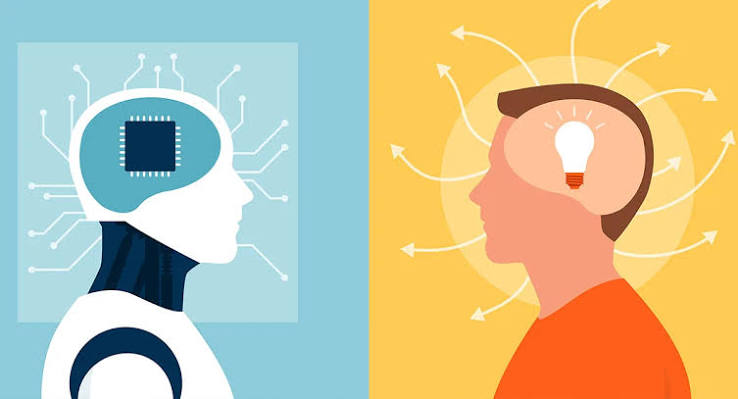
The real question is not “which is better?” It is “which one is better for this job?” AI content writing tools win on throughput. Human writers win on editorial judgment. That split matters because the bottleneck in most content teams is not typing; it is deciding what to say, what to omit, and what the reader will believe.
AI tools can produce a first draft in minutes, often with acceptable grammar and a usable structure. That makes them useful for outline generation, variation, repurposing, and routine copy where the stakes are low. Human writers are slower, but they see nuance: when a claim is too broad, when a feature list needs proof, when a headline promises more than the page can deliver.
That difference shows up most in high-stakes content. A product page, policy page, medical explainer, or B2B sales page often needs facts placed in the right order, tone adjusted to a skeptical reader, and claims softened when evidence is thin. AI can imitate the shape of that writing. It is much less reliable at carrying the reasoning.
The practical test is simple: if a bad sentence wastes time, AI may be enough. If a bad sentence creates confusion, weakens trust, or triggers legal review, I would choose a human writer.
AI content writing tools vs human content writers: the side-by-side
AI wins on production speed; humans win on final quality control. Instead of comparing vague promises, compare the criteria that actually change the outcome.
| Criteria | AI content writing tools | Human content writers | Winner for [condition] |
|---|---|---|---|
| Draft speed | Can generate an outline or rough draft in minutes | Slower, because thinking and revision take time | AI for first drafts under deadline |
| Voice and nuance | Can mimic tone, but often sounds generic on close reading | Can shape a voice that fits a brand or audience | Human for brand-sensitive copy |
| Accuracy and sourcing | May invent or blur facts unless closely supervised | Can verify claims and flag weak evidence | Human for factual content |
| Original thinking | Good at recombining known patterns | Better at reframing the problem or angle | Human for thought leadership |
| Volume at scale | Strong for variations, templates, and bulk content | Expensive to scale line by line | AI for high-volume production |
| Conversion copy | Can draft options, but needs heavy editing | Better at argument, objection handling, and positioning | Human for landing pages |
| Compliance risk | Higher risk if used without review | Lower risk when trained on rules and context | Human for regulated topics |
| Editing load | Saves time only when prompts and review are disciplined | Less cleanup if the writer is experienced | Human when edit time is limited |
| Consistency across many pages | Can stay structurally consistent | Can drift in tone across a large program | AI for templated content |
| Cost structure | Lower marginal cost per draft | Higher cost, especially for specialist writers | AI for budget-constrained teams |
The table points to one conclusion: AI is best when the work is repetitive and the cost of imperfection is low. Human writers are better when the work must persuade, differentiate, or withstand fact-checking. If you are producing 200 product summaries or FAQ variants, AI has a real advantage. If you are writing a homepage, a case-study narrative, or anything a prospect will use to decide whether to buy, a human usually earns the fee.
AI content writing tools: where they genuinely win

AI tools win when the job is volume, structure, and speed, especially on content with a 300- to 1,000-word target and a repeatable pattern. That is where their strongest use case lives.
Their biggest strength is compression of early-stage work. A writer who once spent 45 minutes building an outline can now ask a model for a passable framework, then spend that time refining the argument. AI also helps with content operations: turning one webinar into five social snippets, turning a long brief into section headings, or generating title variations for an A/B test. In those workflows, the model is acting like a drafting engine, not an author.
AI also handles template-based content better than many people expect. A catalogue page, internal knowledge base entry, or simple explainer often follows a fixed shape. If the facts are supplied clearly, the model can fill that shape quickly and consistently. That consistency is useful for large sites where dozens of pages need the same bones.
The drawback is equally clear. AI tends to flatten distinctions. It reaches for common phrases, overstates certainty, and smooths over the hard part: deciding which point matters most. It can write a paragraph that looks polished while saying very little. That is a problem when the reader is comparing vendors, evaluating expertise, or looking for a point of view.
I would not choose AI alone for any page where a mistaken claim creates legal, medical, financial, or reputational risk. It is also the wrong tool when the audience already knows the subject and will notice generic phrasing in the first 2 sentences. For technical background on model limitations, see the OpenAI GPT-4 technical report and the NIST AI Risk Management Framework.
Human content writers: where they still beat software
Human writers win when the content needs to sound like it came from a person who understands the reader’s situation, not from a system that knows the average pattern. That matters most in sales copy, editorial features, technical explainers, and leadership content.
A good human writer does more than string sentences together. They decide what evidence matters, where the reader may hesitate, and which objection needs to be answered before it surfaces. That judgment is hard to automate because it depends on context: the offer, the market, the audience’s level of trust, and the risk of getting one detail wrong. A 900-word landing page can fail because the proof is weak, not because the prose is dull.
Humans also have a better feel for omission. AI is eager to fill every gap. A skilled writer knows when not to say something, when to narrow a claim, and when to leave room for a stronger proof point later. That restraint makes content sharper. It also reduces cleanup. An experienced writer may take longer up front, but the draft often needs fewer correction rounds than AI output that was assembled too quickly.
The weakness is cost and capacity. A human writer can only produce so much high-quality material in a week, and not every business can afford specialist talent for every page. Human writing also depends heavily on briefing. Give a writer a vague input, and they can still produce elegant nonsense. That is not a flaw of the medium so much as a reminder that good writing cannot rescue a weak strategy.
I would choose a human writer for anything that must build trust, carry a unique point of view, or match a brand voice across a flagship page. I would not choose one for a low-stakes rewrite that needs to ship this afternoon.
What most comparisons get wrong
Most comparisons pretend the choice is binary. It is not. The real decision is where in the workflow each option belongs. AI is often best at the front of the process and humans at the end.
A common mistake is using AI as the sole writer, then pretending the editor can fix everything later. That creates a hidden cost: the editor becomes the real writer, but without the benefit of a proper brief. Another mistake is hiring humans for every repetitive task just because the output sounds better on the first read. If the task is 100 near-identical descriptions, the premium may not be worth it.
There is also a quality trap. AI can make a mediocre process look efficient because the words arrive quickly. But if those words still need a human to rewrite the angle, verify the facts, and tighten the logic, the time saved may shrink to almost nothing. The article length may be done in minutes; the content may still take an hour to make publishable.
The smarter model is usually hybrid. Use AI for ideation, outline variants, summarization, and first-pass drafting. Use humans for strategy, fact checking, voice, and the final edit. That division keeps the machine in the role it handles well and the writer in the role that depends on judgment. The exact split depends on the page type, but the principle does not.
When does the choice flip?
The choice flips to AI when the content is repeatable, low risk, and measured by output volume. It also flips when the team has a strong editor who can catch weak claims quickly. In that case, a model can draft 20 variations of a short article, product description, or email sequence while the editor polishes the best one.
The choice flips to a human when the page is a money page, a reputation page, or a technical explanation. A homepage for a SaaS company, a pricing page, a policy article, and a founder letter all carry enough weight that a generic draft can do real damage. Human writers also win when the audience is specialized. The more niche the reader, the less forgiving they are of vague language.
There are a few exception scenarios where the overall verdict changes:
- You have a tight internal style guide and a very repetitive content model. AI can be enough if the format is rigid and the facts are supplied in advance, such as standardized FAQs or product fields.
- You need one high-stakes page and nothing else. A human is worth the higher cost because the marginal value of getting it right is much greater than the saving from automation.
- You have no editor. AI becomes a liability faster than a helper, because its weaknesses are easiest to miss when nobody has time to review the draft line by line.
- You need a fresh angle in a crowded market. Human writers are still better at turning the same inputs into a distinct argument rather than another polished-sounding summary.
What should you actually choose?
Choose AI content writing tools if your main problem is output speed, content volume, or first-draft generation. Choose human content writers if your main problem is trust, differentiation, or conversion. Neither if you cannot review the content before it goes live.
That is the cleanest answer I can give. If the page is low risk and repetitive, AI is the better tool. If the page must persuade a skeptical reader, a human writer is the safer bet. If you are in healthcare, finance, or law, or touching regulated claims, get a qualified professional to review the final copy before publication; consult a professional before relying on any draft in those settings.
The most practical teams do not treat this as a religion; if the topic is legal, medical, or financial, consult a professional and use published guidance from NIST before shipping. They use AI where the work is mechanical and humans where the work is consequential. That is the split that usually keeps both quality and cost under control.
Quick answers to common questions
Can AI content writing tools replace human writers?
No, not for work that depends on judgment, trust, or originality. They can replace parts of the drafting process, especially templates and rough outlines, but not the full editorial function.
Are human writers always better?
No. For bulk content, simple rewrites, and structured variations, humans are often too slow and too expensive for the job.
Is AI content good enough for SEO?
Sometimes, but only when a human reviews the facts, adds specificity, and makes the page genuinely useful. Search engines reward usefulness, not just grammatical sentences.
What is the safest workflow?
Use AI for ideation and first drafts, then have a human edit for accuracy, voice, and logic before publication.
Should I stop hiring writers if I use AI?
No. I would hire fewer people for repetitive drafting and keep stronger humans for strategy, editing, and high-stakes pages.
Drafted with AI; not yet reviewed by a person.