How to Find Content Writers for Webinar Follow-Up Content
How to find content writers for webinar follow-up content: In most cases, hire one writer who can turn a 45-minute webinar into a recap article, an email…
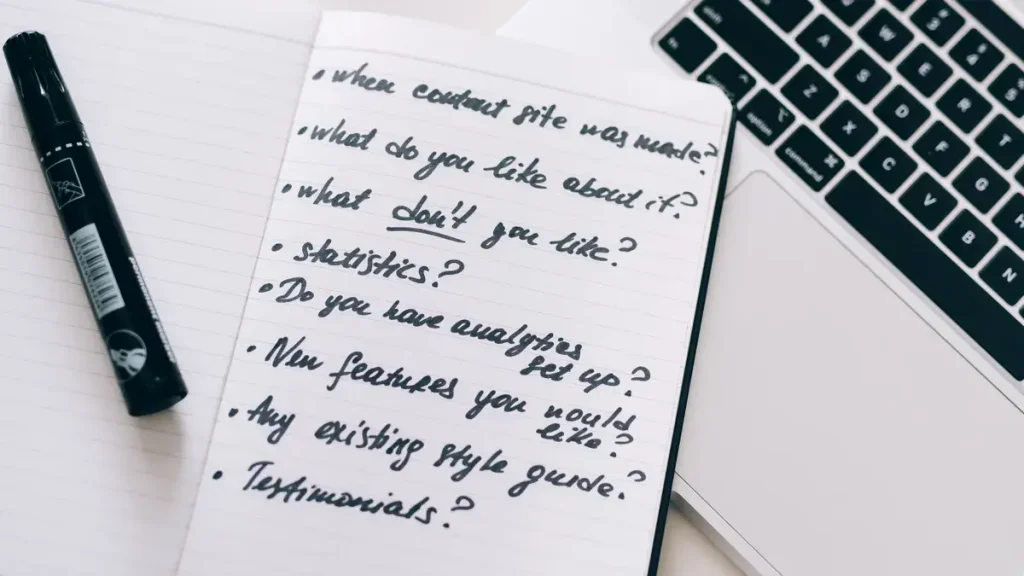
Notebook with handwritten content planning questions beside a laptop
Last updated: November 12, 2026
Quick Answer: In most cases, hire one writer who can turn a 45-minute webinar into a recap article, an email follow-up, and CTA copy from a transcript, slides, and speaker notes. Webinar follow-up content is hard to outsource because it starts with a live recording, not a blank page. Find a writer who can turn the recording, transcript, slides, and speaker notes into a recap article, email follow-up, and CTA copy without flattening the voice. The steps below show how to hire for that job and avoid the usual misses.
What webinar follow-up content actually includes
Webinar follow-up content is the set of assets you publish after the event to keep the conversation going. It usually includes a recap article, a short email follow-up, key takeaways, speaker quotes, and a call-to-action that fits the next step.
Picture this: you’ve got a 45-minute webinar, a raw transcript, and a deck with 18 slides. You don’t need one generic writer. You need someone who can pick out the 3 to 5 ideas that matter and turn them into usable assets fast. That means judging for structure, not just style. In a webinar follow-up package, 3 to 5 core ideas are often enough.
A writer for this work should be able to handle:
- a webinar recording, even if the audio is messy
- an event transcript with filler words and false starts
- speaker notes that contain the real message behind the slides
- presentation slides that show the order of the talk, not just the claims
- CTA adaptation, so the follow-up points to the right action
A paid sample can help you test this without giving away the whole project. Ask for a mini sample from 2 slides and 1 page of transcript. If the sample only rewrites the talk line by line, keep looking.
This page fits the larger hub on how to hire content writers for specific content needs, but the test here is narrower: can the person turn one live session into several follow-up assets that still feel tied to the event?
Where do I find content writers for webinar follow-up content?
You find them where writers already handle source-heavy work, then screen for webinar-specific habits. Start with freelance marketplaces, content agencies, LinkedIn, and writers who already do event recaps, B2B blog posts, or email copy.
Picture this: you post “webinar follow-up writer needed” and get ten replies in an hour. Most are too broad. The trick is not volume. It’s finding people who know how to move from spoken content to written assets without guessing at the message. Look for writers who ask about the transcript, slides, and CTA on day one. A 10-reply stack can still hide only 1 good fit.
Use these places first:
- Freelance platforms with writing portfolios, so you can search for recap articles and email samples.
- LinkedIn, where you can scan for writers who mention webinars, B2B content, or event marketing.
- Content agencies that staff research-heavy writers and editors.
- Industry communities where event marketers or demand gen teams recommend writers by name.
- Writer portfolios with a visible before-and-after example: webinar notes on one side, published content on the other.
A generic writer profile is not enough. You want evidence of transformation work. If the portfolio only shows blog articles from a brief, that’s a weaker match than a writer who has turned a 60-minute talk into a summary email and a 900-word recap.
If you need a fast filter, search for these terms in portfolios and bios:
- webinar recap
- event summary
- B2B email sequence
- executive ghostwriting
- content repurposing from source material
The catch is that “repurposing” alone can mean almost anything. A strong fit for this page understands event context, speaker quotes, and CTA timing. A weak fit writes pretty paragraphs and misses the point.
How do I screen a writer for webinar follow-up work?
You screen a writer by giving them source material and checking whether they can separate signal from noise in one pass. A 20- to 30-minute paid sample based on a transcript excerpt, one slide deck, and the webinar goal is a practical test.
Picture this: you’re not hiring a poet. You’re hiring someone who can hear a 50-minute session and know which 4 moments deserve a headline, which quote should be trimmed, and which CTA should be softened. That takes judgment, not just grammar.
Use this checklist when you review candidates:
- Can they turn a 2-page excerpt into a clear outline?
- Do they identify the speaker’s main promise in plain English?
- Do they pull quotes that sound real, not polished beyond recognition?
- Do they keep the webinar’s point of view intact?
- Do they know when the CTA should be “book a demo,” “read the guide,” or “watch the replay”?
A good screen includes one messy detail on purpose. Give them a transcript with “you know,” “sort of,” and half-finished sentences. Then see whether they clean it up without changing meaning. That matters because webinar transcripts are rarely neat.
You should also ask for a short note on structure. A writer who can explain why the recap should open with the problem, then the answer, then the next step is usually safer than one who only delivers polished copy. Ask for the logic in 3 or 4 sentences, not a long essay.
Avoid this mistake: hiring from a blog article sample alone. Blog writing and webinar follow-up writing are cousins, not twins. Blog work often starts from a clean brief; webinar follow-up starts from a live conversation, speaker notes, and an audience that already heard the pitch once. Different muscle.
What should the brief include?
Your brief should include the goal, audience, source assets, tone, and the exact deliverables. If you leave out any of those, the writer will spend the first round guessing, and the draft will show it.
Picture this: you hand over a 90-minute recording and say, “Can you make something from this?” That is not a brief. It’s a puzzle with missing pieces. A useful brief names the outputs before the writer touches the transcript.
Include these items:
- webinar title and date
- target reader
- business goal of the follow-up content
- the exact assets you want: recap article, email follow-up, key takeaways, speaker quotes, CTA adaptation
- transcript, recording, speaker notes, and presentation slides
- preferred voice, terms to avoid, and approved claims
- links or references the writer can use for factual checks
- deadline for first draft and review pass
A solid brief also says what not to do. For example, tell the writer not to invent new points that were never said on the webinar, and not to turn a recap into a sales page unless that is the actual goal. That one line saves a lot of cleanup.
The brief should also rank the assets. If the email follow-up matters more than the article, say so. If the recap article will carry the main SEO value, say that too. Writers make better choices when they know what is primary and what is support.
One more thing: give the writer the raw material in a clean folder. A transcript in one file, slides in another, and speaker notes in another saves time and reduces errors. A zipped mess does the opposite.
What makes a good sample task for this kind of writer?
A good sample task gives the writer just enough material to show judgment without asking for free work on the whole webinar. The sweet spot is a 300- to 500-word excerpt, one short slide set, or a 2-step outline request.
Picture this: you want proof, but you don’t want to run a full editorial project as a screening tool. Fair. A sample task should show how the writer handles source material, not how much unpaid labor they’ll do. Small, targeted tests work better than a giant mock project.
A sample task might ask for:
- a headline and intro for a recap article
- three bullet key takeaways
- a short follow-up email subject line and opening
- one quote cleaned up from transcript form
- a CTA adapted for readers who missed the live event
The goal is to see whether the writer can choose what matters. If they turn every line into polished copy, they may be overworking the material. If they keep every stumble and filler word, they may not know how to edit for readability.
A sample should also show whether they can preserve the speaker’s point of view. In webinar follow-up content, the speaker’s phrasing often carries the trust signal. The writer does not need to copy it word for word. They do need to keep the promise, the sequence, and the tone recognizable.
Here’s the catch: a sample task is not the same as a full SEO brief. You are screening for source handling, content judgment, and asset thinking. Search terms and keyword maps can come later, once you know the writer can actually shape the material.
What mistakes should I watch for?
You should watch for writers who treat webinar follow-up like a blog article rewrite, because that usually flattens the event and weakens the CTA. The most common errors are easy to spot once you know the cost of each one. If you’re unsure whether a rewrite is the right move, consult a content strategist or editor.
Picture this: the recap article reads fine, but it sounds like it could have come from anywhere. That means the writer missed the live event’s real value. The job is to preserve the event’s spine, not just its topic.
Common mistakes to flag:
- Generic summary — cost: the recap sounds interchangeable; fix: ask for the top 3 takeaways and the strongest quote first.
- Overwritten quotes — cost: the speaker loses their voice; fix: require quote edits that stay close to the transcript.
- Wrong CTA — cost: readers get pushed too hard or too soon; fix: match the CTA to the audience stage.
- No audience filter — cost: the article speaks to everyone and lands with no one; fix: define the reader before drafting.
- Too many ideas — cost: the article feels crowded; fix: cut to one main theme and 2 or 3 supporting points.
You should also watch for writers who need every fact cleaned up for them. Webinar follow-up work often includes claims, product names, and slide language that must stay accurate. A writer who keeps asking vague questions after getting the transcript may struggle with source-heavy work.
A writer with sharp judgment asks better questions instead:
- Which speaker quote should be the lead?
- What should the reader do after finishing the recap?
- Which slide contains the strongest proof point?
- Are there any claims that need sign-off before publication?
That kind of question saves time. It also shows the writer understands the difference between content production and content interpretation.
How do I decide who to hire?
You decide by comparing source handling, editorial judgment, and turnaround, not by who writes the prettiest sample. The right writer is the one who can turn a transcript, slides, and notes into clean assets with the least correction.
Picture this: two candidates both write well. One asks about the transcript, the recording, and the CTA. The other asks about “making it engaging.” The first one is usually the safer bet. Specific questions beat vague enthusiasm.
Use a simple hiring scorecard:
- understands webinar follow-up content
- can work from transcript and slides
- can write recap, email, quotes, and takeaways
- keeps the speaker’s voice intact
- asks clear questions before drafting
- can hit your deadline without hand-holding
If you’re choosing between a generalist and a specialist, pick the person who has already done event-based content, even if their portfolio is smaller. A smaller, sharper fit beats a broad portfolio full of unrelated work.
Cost matters too, but it should not be the only filter. A cheaper writer who needs heavy rewriting can cost more than a stronger writer with a cleaner process. The hidden cost in this work is editorial time. If you are spending an extra hour fixing the recap and another hour fixing the email, the “save” disappears fast.
The truth is, the best hire for webinar follow-up content is often not the fanciest writer in the stack. It’s the one who can treat the webinar as source material, not as a transcript to polish. That’s the whole game.
What content comes after a webinar?
The most common follow-up pieces are a recap article, an email follow-up, speaker quotes, key takeaways, and a CTA that points to the next step. The right mix depends on the webinar goal and the audience stage. A product demo usually needs a different follow-up package than an educational session.
Can a writer turn a webinar into articles?
Yes, if the writer can work from the recording, transcript, slides, and speaker notes without inventing new points. A strong writer can turn one webinar into a recap article and smaller support pieces, but the job is harder than standard blog writing. The source material has to stay accurate while the prose stays readable.
How do I brief a writer on a webinar recording?
Give the writer the recording, transcript, slides, speaker notes, audience, goal, and the exact deliverables you want. Say which CTA matters most and which claims need approval. The clearer the source packet, the less time the writer spends guessing and the less cleanup you’ll need later.
Drafted with AI; not yet reviewed by a person.